
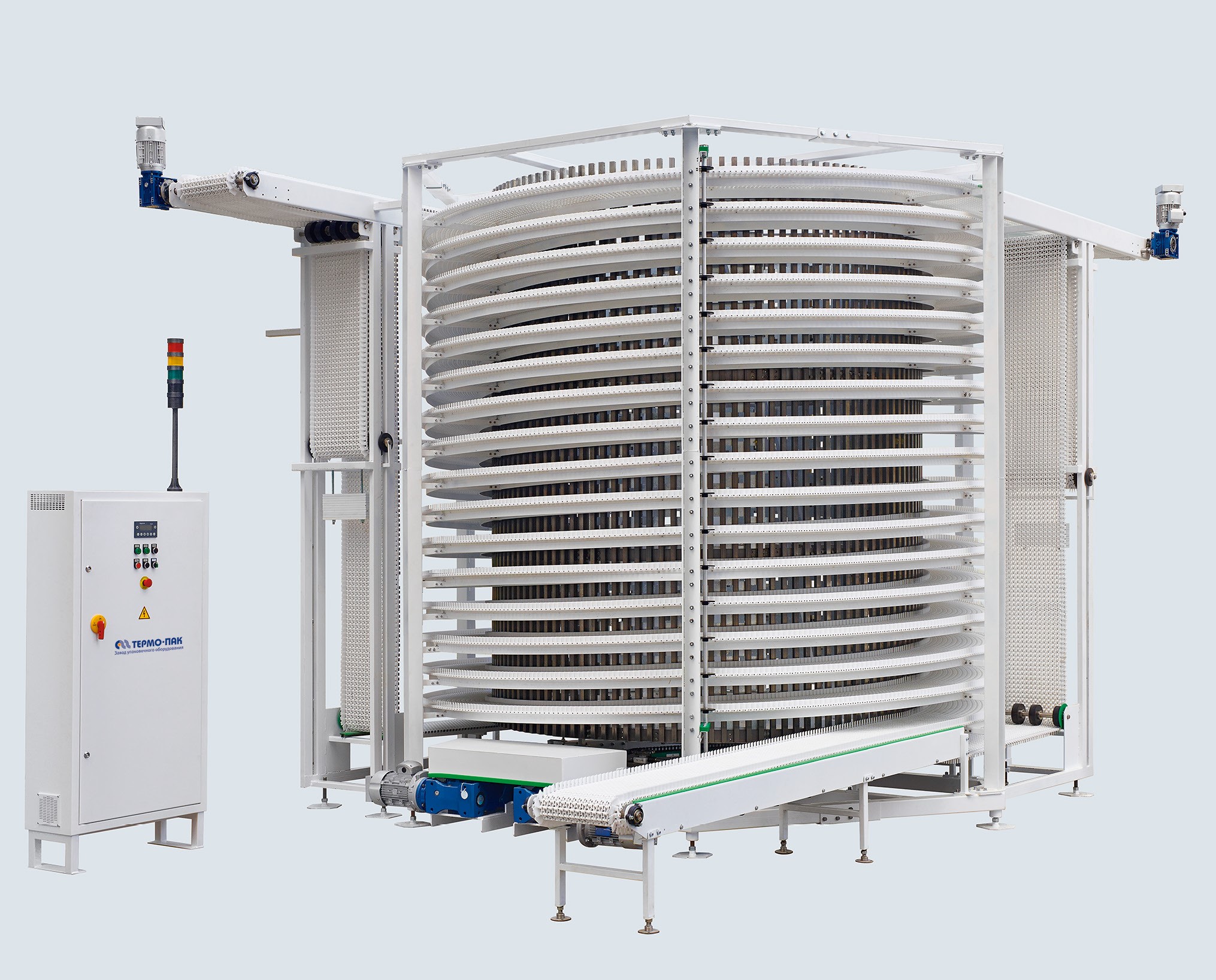
A spiral conveyor is used for cooling and freezing semi-finished products by moving them at the required speed to a specified height. During the product’s movement on the conveyor belt, it cools down and reaches a certain temperature.
One of the advantages of this conveyor is that, with high productivity, it occupies a relatively small area due to its vertical design, which is much more advantageous than installing multiple units of equipment.
Spiral conveyors are also intended for use in refrigeration chambers, proofing of bakery products, and bread cooling.
The undeniable advantage of conveyors of this type is their high productivity with a relatively small footprint. Thanks to the vertical design, the use of a spiral conveyor is more cost-effective than installing multiple units of equipment of comparable power and productivity of the linear type.
The basis of a spiral conveyor is a modular belt.
Modular belts offer numerous advantages compared to regular conveyor belts, such as wear resistance, acid resistance, oil and grease resistance, resistance to heavy loads, the ability to replace damaged or worn modules quickly without replacing the entire belt, as well as easy cleaning, disassembly, and thorough cleaning. The lightweight of the belt increases the motor’s efficiency. Additionally, a significant advantage is the ability to adjust the belt’s length by adding or removing modules as it gradually extends. Using a modular belt in the conveyor’s design allows for the creation of conveyors of very large width and length, incorporating turns, inclines, and screw-like sections without the need for intermediate drive stations and drives.
The use of modular belts enables the construction of conveyors with a total belt length exceeding 400 meters!
Therefore, modular conveyor belts, in most cases, stand out for their interchangeability, structural technological advantages, and durability.
Modular belts can be employed in various applications, including:
• In meat and fish processing processes.
• For transporting and cooling bakery products.
• For processing and freezing vegetables and fruits.
• For shock freezing dumplings, pierogies, and semi-finished products.
Modular belts:
• Operate within a wide temperature range (from -70°C to +190°C).
• Are easy to install and disassemble.
• Are repair-friendly.
• Offer a broad range of product contact area adjustments (from 10% to 90%).
• Clean well with hot and active solutions.
• Are approved for contact with food products.
• Are resistant to chemical substances.
• Require minimal ongoing maintenance.
Nitrile – white belt for food applications, excellent resistance to oils and fats, tasteless and odorless, good wear resistance, compliant with FDA-USDA standards.
The material used to manufacture modular belts is: Polyamide – PA6,
Polyamide PA6 – possesses good mechanical properties and chemical resistance. It also boasts high wear resistance.
Operating temperature range: From -40 to +120°C.
Polyamide – PA6.6
Operating temperature range: From -40°C to +140°C
What is the frequency of defrosting and freezing?
The defrosting process is not required since, during a product assortment change, it is necessary to clean the modular conveyor belt. This eliminates the need for defrosting. (as per information from the Drygalo company).
The cleaning process takes approximately 40 to 60 minutes. This aligns with the time it takes for the scheduled product changeover to return to its designated position, completing the entire cycle.
The belt cleaning is performed using a specialized device that directs high-pressure jets of warm water through nozzles onto the free section of the belt before it enters the refrigeration unit. Immediately after cleaning, the belt is automatically dried with compressed air before entering the refrigeration chamber. The compressed air undergoes special preparation and purification.